
Use the dew point. It measures how much water vapour is actually in the air, so it tracks how sticky the air feels. Below 10 °C (50 °F) the air feels dry, 10 to 16 °C (50 to 60 °F) is comfortable, 16 to 21 °C (60 to 70 °F) is sticky to muggy, and above 21 °C (70 °F) is oppressive. Relative humidity only tells you how close the air is to saturation at its current temperature.
What relative humidity measures
Warm air can hold more water vapour than cold air. Relative humidity is the amount of vapour in the air as a percentage of the most it could hold at its current temperature.
That "at its current temperature" is the catch. Take a parcel of air and warm it up without adding or removing any water, and its relative humidity falls. Cool it down and the figure rises. This is why humidity is nearly always highest at dawn and lowest in mid-afternoon, even on days when the air itself has not changed at all.
What dew point measures
The dew point is the temperature to which the air would have to cool for its water vapour to start condensing. The more vapour in the air, the higher the dew point.
Because it depends only on the amount of water, the dew point barely moves through the day. It changes when the air mass changes: when a sea breeze arrives, when a front passes, when rain evaporates into dry air.
The same air, two very different humidity readings
| Situation | Temperature | Humidity | Dew point | How it feels |
|---|---|---|---|---|
| Cool morning | 10 °C (50 °F) | 90% | 8 °C (47 °F) | Fresh and crisp |
| Hot afternoon | 32 °C (90 °F) | 50% | 20 °C (69 °F) | Heavy and sticky |
The morning has almost double the relative humidity and feels far drier, because there is much less water in the air. Your body cools itself by evaporating sweat, and how well that works depends on how much vapour the air already holds, which is exactly what the dew point tells you.
The dew point comfort scale
People who live in humid climates tolerate higher dew points, so shift the scale by a couple of degrees to suit yourself. The order never changes.
What else the dew point tells you
- Fog and dew. When the evening temperature is only a couple of degrees above the dew point and the wind is light, expect dew on the grass and possibly fog by morning. More in how fog forms.
- Tonight's low. On a calm clear night the temperature rarely falls far below the evening dew point, because condensation releases heat. It is a handy floor for the overnight minimum.
- Frost. A dew point below 0 °C (32 °F) with clear skies means frost rather than dew.
- Thunderstorms. Moisture is fuel. Dew points above about 18 °C (65 °F) give storms much more to work with.
- How hot it feels. The heat index rises steeply with the dew point.
- Dry indoor air. A very low dew point outside means parched air inside once it is heated, and more static shocks.
Dew point and humidity in Magic Weather
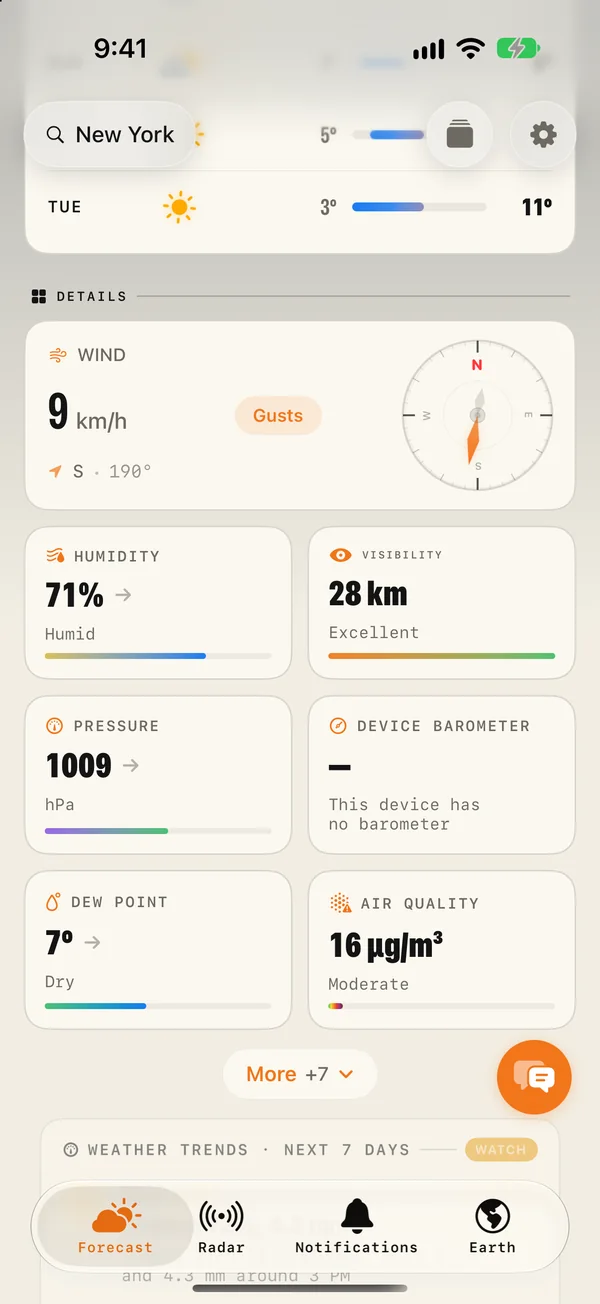
- The Dew point tile shows the value with a rating from dry to very humid.
- The Humidity tile shows the percentage with a plain word and an arrow for where it is heading.
- Tap either tile to open its hour-by-hour timeline with the low, average and high.
- Open any day in the week and switch the chart to Humidity to see how it moves from dawn to afternoon.
- The hourly forecast menu can show dew point as a curve for the next 24 hours.
Common questions
What is a comfortable dew point?
Most people find dew points between 10 and 16 °C (50 to 60 °F) comfortable. Above 18 °C (65 °F) the air starts to feel muggy, and above 21 °C (70 °F) it feels oppressive.
Is dew point or humidity more important?
For comfort, dew point. Relative humidity depends on the temperature, so the same air can read 90% at dawn and 40% in the afternoon. The dew point stays nearly the same and matches how the air feels.
Can the dew point be higher than the temperature?
No. When the air cools to its dew point it is saturated, and water starts to condense as dew, fog or cloud. The dew point is always at or below the air temperature.
What dew point causes fog?
Fog forms when the air temperature falls to within about 2 °C (4 °F) of the dew point and the wind is light. The closer the two numbers, the more likely fog becomes.