
Static shocks happen when dry air lets electric charge build up on your body instead of leaking away. Cold air holds very little water vapour, and heating it indoors drops its relative humidity to 20% or less. Shocks become common when indoor humidity falls below about 40%. Raising it to between 40 and 50% with a humidifier is the most reliable fix.
How the charge builds up
When two different materials touch and separate, electrons move from one to the other. Shoes on carpet, a jumper pulled over a shirt, your back sliding off a car seat: each leaves you with a small surplus or shortage of electrons. Do it enough and your body can reach several thousand volts.
That charge wants to escape. In damp air it drains away quietly, through the thin film of water that covers most surfaces and through the air itself. In dry air it has nowhere to go, so it waits until your hand comes close to a conductor such as a door handle, and then jumps the gap as a spark.
You feel a shock from about 2,000 to 3,000 volts upward. One you can hear is usually above 5,000.
Why winter air is so dry indoors
This is the part that links static to the forecast. Cold air cannot hold much water vapour. Outside, a winter day at 0 °C and 80% relative humidity feels damp. Bring that same air inside and heat it to 21 °C without adding water, and its relative humidity falls to about 20%, drier than most deserts.
| Outside | Dew point | Same air heated to 21 °C (70 °F) |
|---|---|---|
| 10 °C (50 °F), 80% humidity | 7 °C (44 °F) | About 40% |
| 0 °C (32 °F), 80% humidity | −3 °C (27 °F) | About 20% |
| −10 °C (14 °F), 80% humidity | −13 °C (9 °F) | About 9% |
The number that predicts this is the dew point, which measures how much water is actually in the air. The outdoor humidity percentage tells you almost nothing about it.
This is also why shocks come in spells. A cold, dry air mass arrives behind a front, the dew point drops below freezing, and for a few days everything sparks. Then milder, damper air returns and it stops.
How to stop the shocks
Fix the air
- Use a humidifier. Aim for 40 to 50% indoors. This is the single most effective fix, and it also helps dry skin, lips and throats.
- Do not go above about 55%. In a cold climate, too much moisture condenses on windows and feeds mould.
- Small sources help: drying laundry indoors, houseplants, leaving the bathroom door open after a shower.
Change what you wear
- Shoes. Rubber soles insulate you and let charge build. Leather soles let it leak away.
- Fabrics. Wool and synthetics such as polyester and nylon charge easily, especially against each other. Cotton is much better.
- Skin. Dry skin holds charge. Moisturiser makes a real difference.
Discharge on your own terms
- Touch metal with a key or a coin first. The spark jumps to the metal object instead of your fingertip, and you feel nothing.
- Touch with your knuckles or the flat of your hand. A larger area with fewer nerve endings.
- Getting out of a car: hold the metal door frame before your feet reach the ground.
- Touch a wall or a wooden door first. They conduct just enough to drain the charge slowly.
When it matters more than comfort
- Refuelling. Touch the car body before you touch the pump nozzle, and do not get back into the car while fuel is flowing.
- Electronics. Touch the metal case of a computer before handling its parts. A spark far too small to feel can damage a chip.
Shock days in Magic Weather
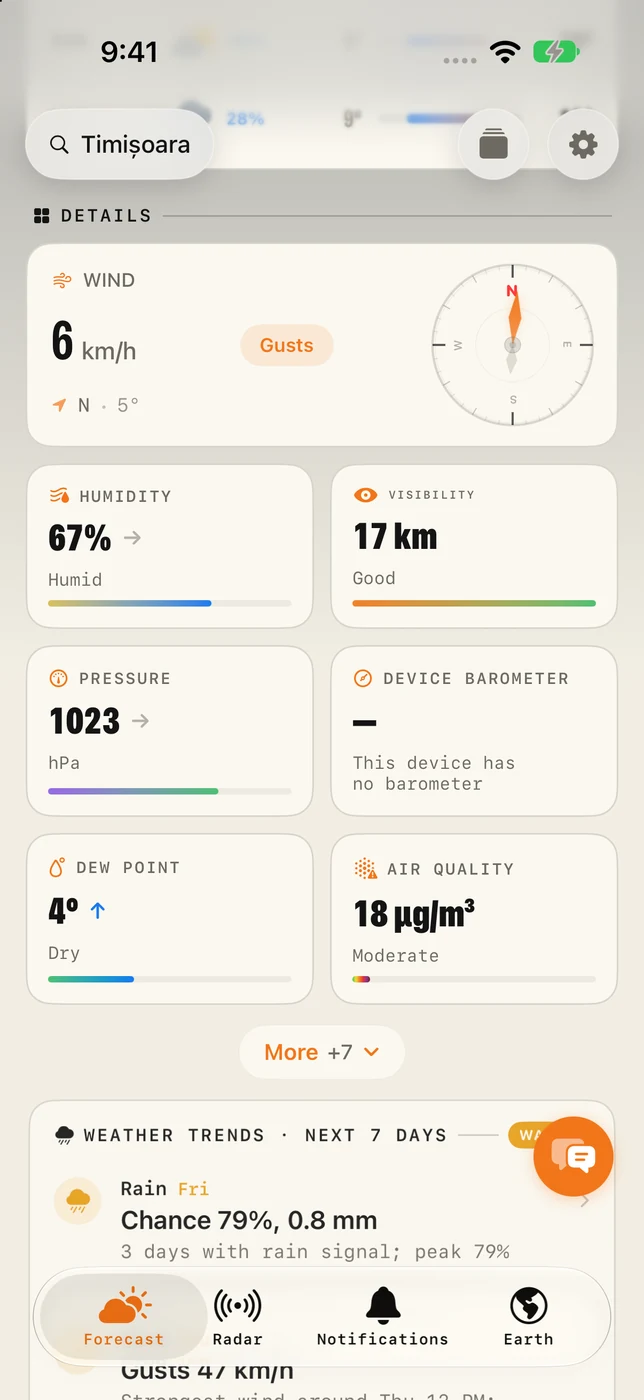
- Static shock risk is one of the experimental alerts in the Beta Notifications section. It warns you on the days when the air is dry enough for shocks.
- The Dew point tile shows the value and a rating. When it reads "Dry" and the outdoor temperature is low, expect sparks.
- The Humidity tile shows the outdoor percentage and where it is heading.
- Both have timelines, so you can see a dry spell arriving a few days ahead and get the humidifier out.
Common questions
At what humidity do static shocks happen?
Shocks become noticeable when relative humidity indoors falls below about 40%, and frequent below 30%. Above about 50%, a thin film of moisture on surfaces lets charge leak away before it can build up.
Why is static worse in winter?
Cold air holds little water vapour. When that air is brought indoors and heated, its relative humidity drops sharply, often to 10 to 20%. Dry air and dry surfaces are good insulators, so charge stays on you until you touch something metal.
Are static shocks dangerous?
For a healthy person, no. The voltage can be thousands of volts, but the amount of charge is tiny and it lasts a fraction of a millisecond. They can damage sensitive electronics and are a real hazard around fuel vapour, which is why you should touch the car body before refuelling.
How do I stop getting shocked by my car?
As you get out, hold a metal part of the door frame before your feet touch the ground, and keep holding it until you are standing. The charge flows away harmlessly through your hand instead of jumping as a spark.