Falling pressure means a low is approaching, bringing cloud, wind and rain. Rising pressure means clearer, calmer weather is on the way. The trend matters more than the number: a fall of more than about 1.5 hPa in three hours is worth noticing, and a fall of more than 6 hPa in three hours means a strong storm is close.
What air pressure is
Air has weight. Barometric pressure is the weight of the column of air above you, pressing down on every surface. At sea level it averages 1013.25 hPa, which is 29.92 inches of mercury, or about ten tonnes pressing on every square metre.
That weight is not the same everywhere. Where air is sinking, it piles up and the pressure is higher. Where air is rising, the pressure underneath is lower. Those two cases produce most of the weather you experience.
Highs and lows
| High pressure | Low pressure | |
|---|---|---|
| Air movement | Sinks and warms | Rises and cools |
| Sky | Clear or thin cloud | Thick cloud |
| Weather | Dry, settled. Hot in summer, cold and frosty or foggy in winter. | Rain or snow, wind, changeable. |
| Wind | Light near the centre | Stronger, especially where the isobars are close together |
| Typical value | Above 1020 hPa | Below 1000 hPa |
The extremes are remarkable. The lowest sea-level pressure ever measured was 870 hPa, in the eye of Typhoon Tip in 1979. The highest was about 1084 hPa, in a Siberian winter.
The trend is the forecast
A single pressure reading tells you little. The same 1008 hPa can come before a storm or after one. What matters is which way the needle is moving and how fast. These are the terms used in marine forecasts, measured over three hours:
Some rules that have served for centuries:
- Falling steadily: a low is approaching. Cloud thickens, wind picks up, rain follows.
- Falling fast: the low is deep or close. Expect strong wind. A storm that deepens by 24 hPa in 24 hours is called a "bomb cyclone".
- Rising after a low: the worst has passed, though the strongest gusts often come just as the pressure starts to climb.
- Rising slowly and staying high: settled weather for days.
- High but falling slowly: the fine spell is ending.
Sea-level pressure and the pressure where you stand
Pressure drops as you climb, by about 1 hPa for every 8 metres near sea level. A town at 400 metres has a real pressure about 48 hPa lower than the coast on the same day.
To make weather maps readable, forecasts adjust every reading to what it would be at sea level. That is the number you see in a weather app. A barometer in your hand, including the one in your phone, measures the actual pressure at your height, which is why the two values differ unless you live by the sea.
For forecasting, this does not matter. The change over a few hours is the same either way, as long as you stay at the same height.
The barometer in your pocket
Nearly every iPhone made since 2014 and every recent Apple Watch contains a pressure sensor. It was added to count flights of stairs, and it is sensitive enough to notice the pressure difference between your desk and the floor.
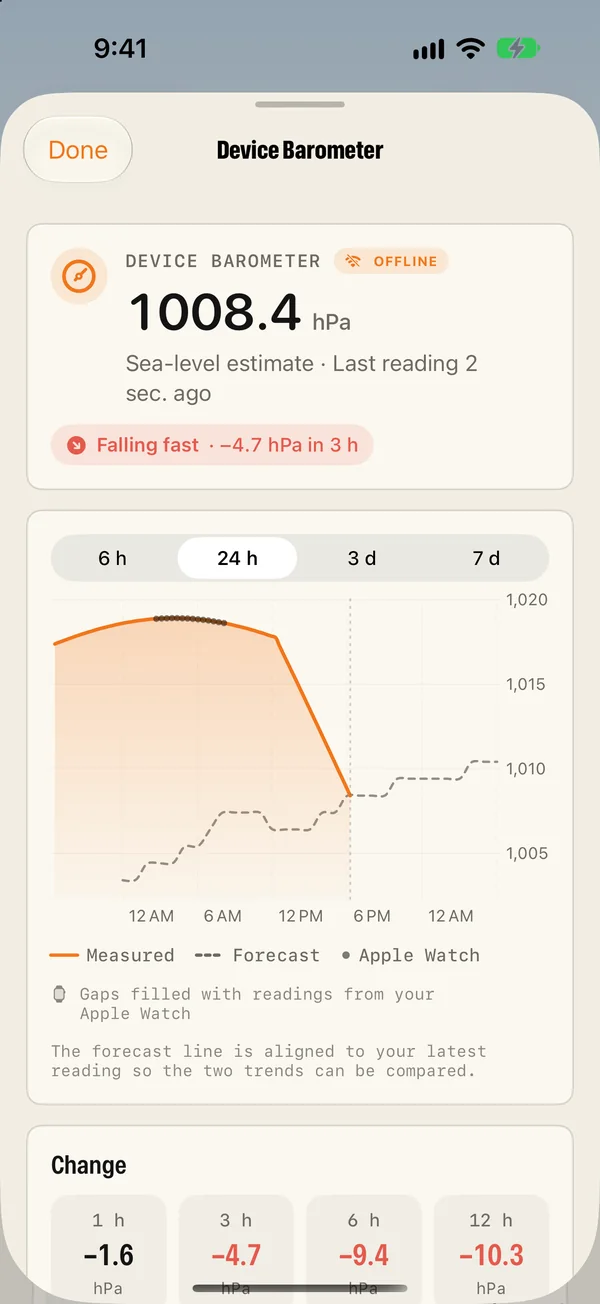
That makes your phone a real weather instrument. It can notice a fast pressure fall before any forecast reaches you, even with no signal. Magic Weather uses it for exactly that: see using your iPhone's barometer as a storm warning.
Pressure and how you feel
Many people report headaches or aching joints when the pressure changes quickly. The research is mixed but the reports are consistent. Weather and migraines looks at what is known.
Pressure in Magic Weather
- The Pressure tile shows sea-level pressure from the forecast with an arrow for rising, falling or steady. Tap it for the hour-by-hour timeline.
- The Device Barometer tile shows the pressure your own iPhone measures and how fast it is changing.
- Weather Trends flags a significant pressure drop in the coming days and says how many hectopascals it falls.
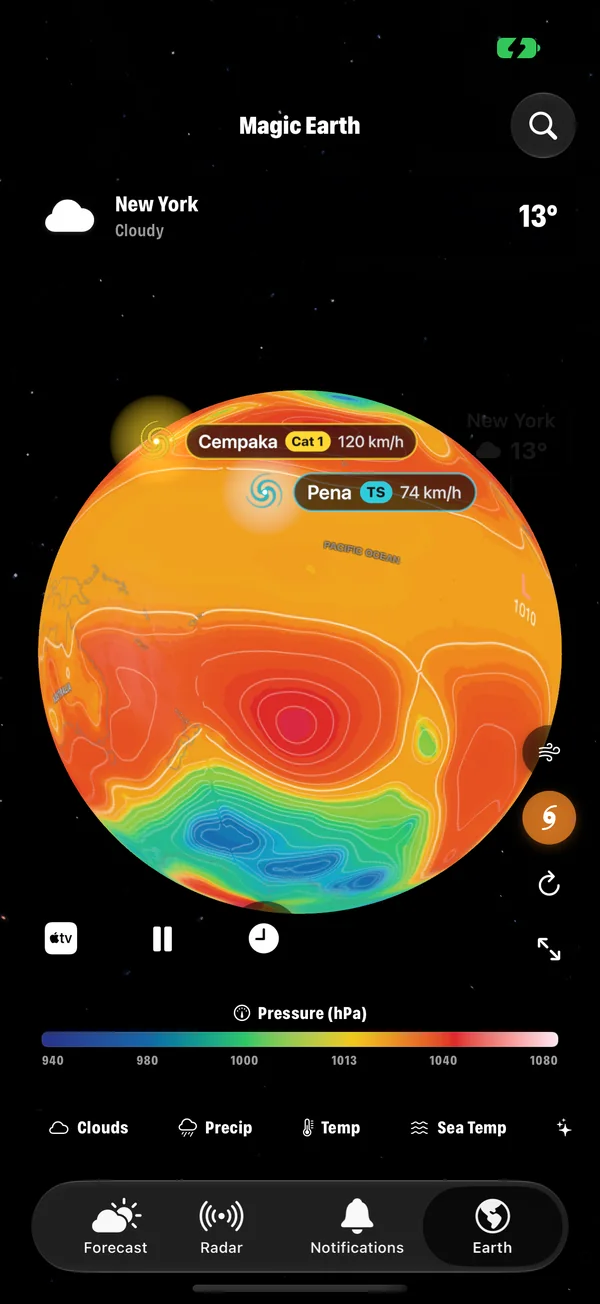
- The Earth tab has a Pressure layer, so you can see the highs and lows that are steering your weather.
- Units: hPa, mbar or inHg, in Settings › General.
Common questions
What is normal barometric pressure?
Average sea-level pressure is 1013.25 hPa (29.92 inHg). Day to day it usually stays between about 980 and 1040 hPa. Anything above 1020 hPa is generally considered high and below 1000 hPa low.
Does low pressure mean rain?
Often, not always. Low pressure means air is rising, which makes cloud and usually rain. A falling barometer is the better signal: pressure that drops steadily for several hours means unsettled weather is approaching.
What is the difference between hPa, mbar and inHg?
Hectopascals (hPa) and millibars (mbar) are the same unit under two names. Inches of mercury (inHg) are used mainly in the United States. One inHg equals 33.86 hPa.
Why does my phone show a different pressure than the forecast?
Your phone measures the pressure where you are standing. Forecasts show pressure adjusted to sea level so that places at different heights can be compared. Pressure falls by about 1 hPa for every 8 metres you climb.
Your iPhone has a barometer. Here is how to use it as a storm warning
Your iPhone measures air pressure. Magic Weather logs it and warns you when it falls fast, even offline. How it works on iPhone and Apple Watch.
Can the weather trigger migraines? What pressure changes really do
Many people with migraine say weather sets it off. Here is what studies show about falling pressure, heat and storms, and how to track your own pattern.
Wind speed vs wind gusts: which number should you plan around?
Wind speed is an average over minutes; a gust is a peak lasting seconds. Learn the difference, the Beaufort scale, and which number to plan around.