
Golden hour is the period just after sunrise and just before sunset when the sun is less than about 6 degrees above the horizon and the light is warm, soft and low. Blue hour is the shorter period before sunrise and after sunset when the sun is 4 to 6 degrees below the horizon and the sky turns deep blue. Golden hour lasts about 25 minutes near the equator and 35 to 60 minutes at mid-latitudes. Blue hour often lasts only 10 to 20 minutes.
Why low sun looks golden
Sunlight is a mix of all colours. Air scatters blue light much more than red, which is why the sky is blue. When the sun is overhead, its light crosses a thin layer of atmosphere and arrives nearly white.
Near the horizon, the same light has to cross up to 38 times more air. Most of the blue is scattered out along the way, leaving yellow, orange and red. The light also arrives almost horizontally, so shadows are long and textures stand out, and it is far less harsh, because the atmosphere has dimmed and diffused it.
The phases by sun angle
What you see depends on where the sun is relative to the horizon, not on the clock.
The period from sunset until the sun is 6 degrees down is called civil twilight. It is the time when you can still do most things outside without a light.
How long they last
The length depends on how steeply the sun crosses the horizon, which depends on your latitude and the season.
| Latitude | Example | Golden hour | Blue hour |
|---|---|---|---|
| 0–15° | Singapore, Nairobi, Bogotá | About 25 minutes, all year | About 8 to 10 minutes |
| 30–40° | Cairo, Los Angeles, Tokyo, Sydney | 30 to 40 minutes | 10 to 15 minutes |
| 45–55° | Paris, London, Vancouver, Berlin | 35 to 45 minutes in spring and autumn, an hour or more in midsummer | 15 to 25 minutes |
| 60°+ | Oslo, Helsinki, Reykjavik, Anchorage | Over an hour. In midsummer it can last most of the night. | 30 minutes or more, or all night in summer |
This is why a tropical sunset feels abrupt and a Scandinavian summer evening seems to go on for ever.
How the weather changes the light
| Sky | What happens |
|---|---|
| Clear | Clean, warm, directional light on the land. The sky itself is fairly plain. |
| Scattered high cloud, clear horizon | The best case. The sun lights the clouds from below and the whole sky turns pink and orange, often peaking 10 to 15 minutes after sunset. |
| Broken mid-level cloud | Dramatic shafts of light and strong colour, if there is a gap where the sun is. |
| Solid overcast | No golden hour at all. The light just fades to grey. |
| Clearing after rain | Very clean air, vivid colour, and a chance of a rainbow opposite the sun. |
| Haze, dust or smoke | A deep red sun you can look at directly, but soft, low-contrast light. |
| Fog or mist | Glowing, diffused light. Excellent at sunrise in valleys. |
The thing to look for in a forecast is the height of the cloud and a gap on the horizon in the direction of the sun. Total cloud cover of 30 to 60% made up of high cloud is promising. 100% low cloud is not.
Planning for it
- Arrive early. The light changes fastest in the last ten minutes. Be in place half an hour before sunset.
- Stay late. The strongest colour often comes after the sun has gone, and blue hour follows straight after that.
- Mind the hills. The sun disappears behind a ridge long before the official sunset time. In a valley, golden hour arrives early and ends early.
- Mornings are quieter and clearer. The air is usually cleaner and calmer at sunrise, with mist in low ground and fewer people.
- Blue hour needs a tripod. There is very little light, and it is the moment when lit buildings and the sky are evenly matched.
Sunrise, sunset and cloud in Magic Weather
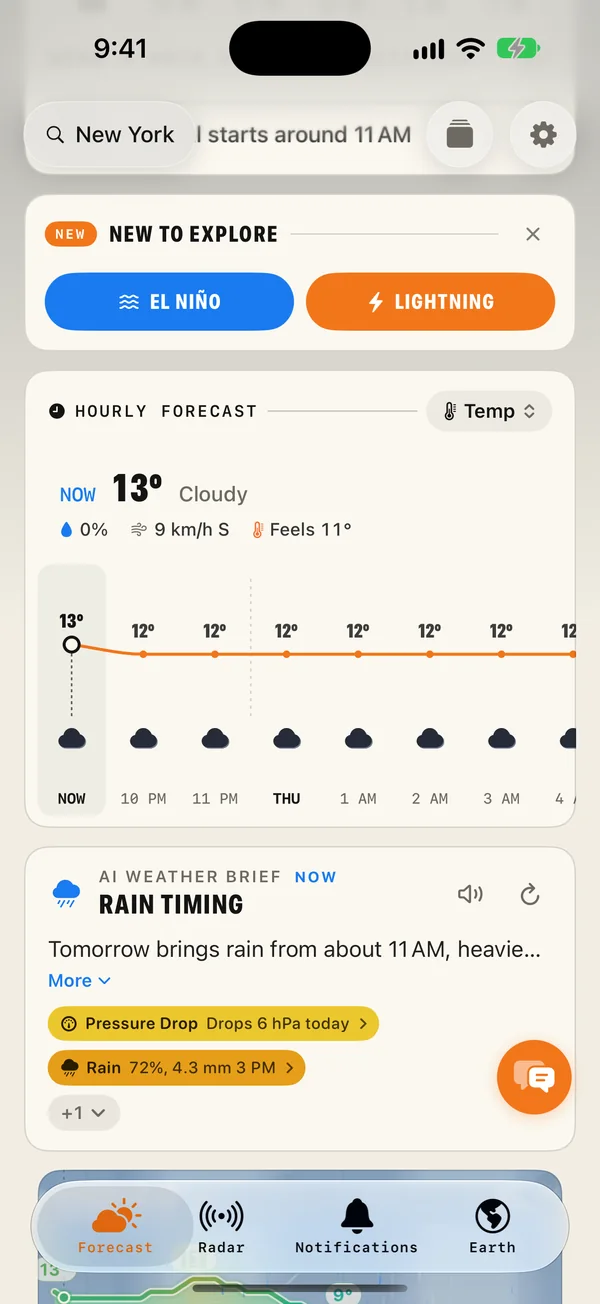
- Sunrise and sunset have their own detail tiles, and both are marked on the hourly forecast strip.
- Cloud cover is a detail tile with an hour-by-hour timeline, so you can see whether the sky is likely to open up at the right moment.
- The weathergraph draws the sky through the day, including day and night, so you can see the light and the cloud together.
- Golden hour is one of the experimental alerts in the Beta Notifications section, alongside rainbow watch and stargazing conditions.
- The Auto theme changes the look of the app with the time of day and the weather, so the app itself follows the light.
Common questions
What time is golden hour?
It is the last stretch before sunset and the first after sunrise, while the sun is within about 6 degrees of the horizon. At mid-latitudes that is roughly the final 35 to 60 minutes of daylight and the first 35 to 60 minutes of the morning.
Is golden hour really an hour?
Rarely. Near the equator the sun sets steeply and golden hour lasts about 25 minutes. At 45 degrees latitude it is about 35 to 45 minutes around the equinoxes and longer in summer. At high latitudes in summer it can last for hours.
What is blue hour?
The short period of twilight when the sun is about 4 to 6 degrees below the horizon. The sky is a deep, even blue, and city lights balance well against it. It comes before golden hour in the morning and after it in the evening.
What weather is best for golden hour photos?
Scattered high or mid-level cloud with a clear gap on the horizon where the sun sets. The clouds catch the colour while the low sun shines underneath them. A completely overcast sky gives flat grey light.