A good stargazing night has little or no cloud, low humidity, light wind, no bright moon and a dark site away from city lights. Check the cloud forecast for the hours after astronomical twilight ends, when the sun is 18 degrees below the horizon. Aim for the week around new moon, and give your eyes 20 to 30 minutes to adapt to the dark.
1. Cloud: amount, height and timing
Cloud is the obvious one, and the detail matters.
- Amount. Under 20% cover is good. Under 10% is excellent.
- Height. Low cloud is a solid lid. Thin high cloud (cirrus) is sneakier: you can see bright stars through it, but faint ones vanish and the sky looks milky. A forecast of "clear" often ignores it.
- Timing. Look at the forecast hour by hour. Skies frequently clear after sunset as the day's heat-driven cloud dies away, and frequently cloud over before dawn.
2. Transparency: what is in the air
A cloudless sky can still be poor if the air is full of moisture, dust or smoke. Astronomers call this transparency.
- Humidity. Damp air scatters light and makes the sky glow, especially near towns. Dry air gives black skies.
- Haze, dust and smoke. Poor air quality dims everything, particularly near the horizon.
- The best nights usually follow a cold front. The rain washes the air clean and dry air moves in behind it.
A quick test: if the daytime sky was a deep blue all the way down to the horizon, the night will be transparent. If it was pale or whitish, expect a washed-out sky.
3. Seeing: how steady the air is
Seeing describes turbulence in the atmosphere. It is what makes stars twinkle. For looking at the Milky Way with your eyes it barely matters. For planets, the moon or double stars through a telescope it is everything.
- Strong twinkling means poor seeing. Planets will look like they are under running water.
- Steady stars mean good seeing. This often comes with calm, slightly hazy conditions under high pressure, which is the opposite of what gives the best transparency.
- Wind at ground level shakes telescopes and chills observers. Under 15 km/h is comfortable.
4. The moon
The moon is the biggest source of natural light pollution. Around full moon the sky is so bright that only a few hundred stars are visible, even from a dark site.
5. Darkness: time and place
Time. The sky is not fully dark until the sun is 18 degrees below the horizon, the end of astronomical twilight. At mid-latitudes that is 90 minutes to two hours after sunset. In summer above about 50 degrees latitude, the sky never gets fully dark at all for several weeks. More in golden hour and blue hour.
Place. Light pollution is measured on the nine-step Bortle scale.
| Bortle | Where | What you can see |
|---|---|---|
| 1–2 | Remote desert, open ocean, high mountains | The Milky Way casts shadows. Thousands of stars. |
| 3–4 | Countryside, an hour or more from a city | Milky Way clear and detailed overhead. |
| 5–6 | Suburbs | Milky Way faint or only overhead. |
| 7–9 | Cities | The moon, planets and the brightest stars. |
Even a short drive helps. Getting a hill or a wood between you and the nearest town makes a noticeable difference.
A checklist for tonight
- Cloud under 20% for the hours after full darkness, with no high cloud.
- Humidity on the low side, and a temperature well above the dew point so that nothing fogs or dews up.
- Wind light.
- Moon below the horizon, or a thin crescent.
- Somewhere dark, facing away from the nearest town.
- Warm clothes. You will be standing still. Dress for 10 degrees colder than the forecast.
- No white light. Dim your phone, use a red torch, and wait 20 to 30 minutes.
What to look for
- The Milky Way. Its bright core is best seen from the Northern Hemisphere between about April and September, low in the south.
- Planets. They do not twinkle, and they are visible even from cities.
- Meteor showers. The Perseids in mid-August and the Geminids in mid-December are the most reliable.
- The aurora, if you are far enough north or the sun is active. See the Kp index explained.
Stargazing conditions in Magic Weather
- Stargazing conditions is one of the experimental alerts in the Beta Notifications section. It lets you know when a good night is coming.
- Cloud cover is a detail tile with an hour-by-hour timeline. Check the hours after dark, not the daily figure.
- Humidity, dew point, visibility and wind each have a tile and a timeline.
- The Earth tab shows the night side of the planet with city lights, a quick way to see where the dark places are.
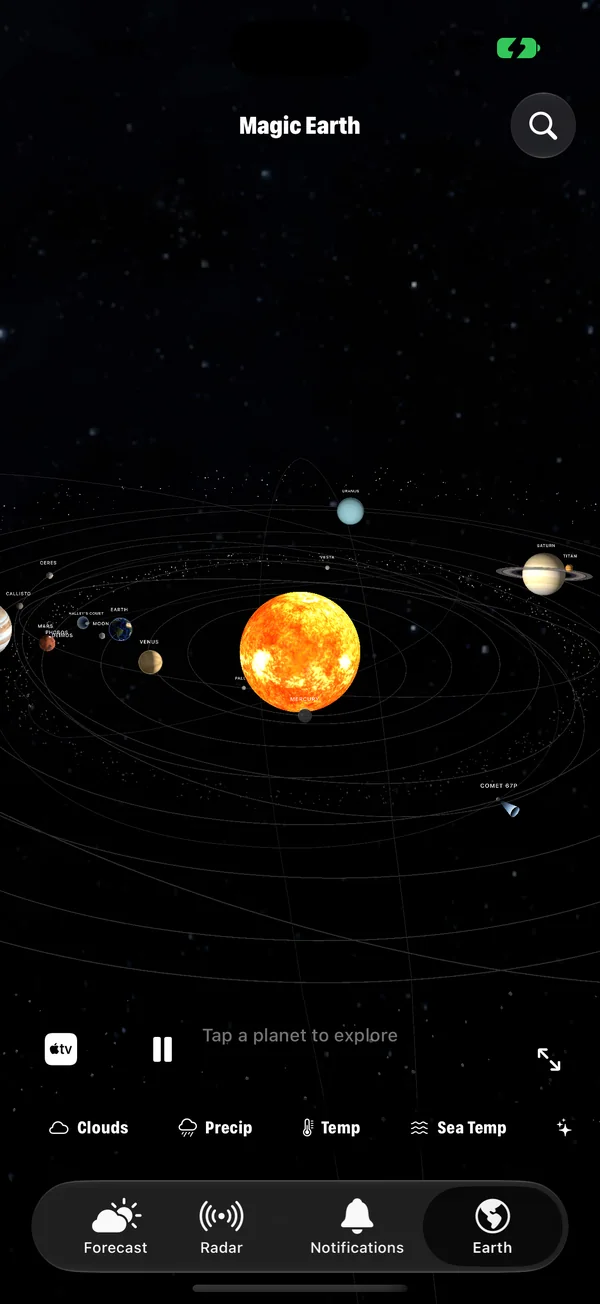
- The solar system view lets you explore the planets while you wait for your eyes to adjust.
Common questions
What cloud cover is good for stargazing?
Under about 20% is good and under 10% is ideal. The type matters as much as the amount: thin high cloud can cover the whole sky and still let bright stars through, but it ruins faint objects such as the Milky Way.
What is the best moon phase for stargazing?
New moon, and the few days either side of it. A full moon brightens the whole sky and hides all but the brightest stars. If the moon is up, observe before it rises or after it sets.
How long do eyes take to adjust to the dark?
About 20 to 30 minutes for full sensitivity. One look at a bright phone screen or a white torch resets most of it. Use a dim red light if you need to see.
Why are winter nights better for stargazing?
Nights are longer and cold air holds less moisture, so the sky is often more transparent. The trade-off is that the air can be more turbulent, which makes stars twinkle and blurs planets in a telescope.