The Kp index measures disturbance in the Earth's magnetic field on a scale from 0 to 9. The higher the number, the further from the poles the aurora can be seen. Kp 2 to 3 is enough in northern Scandinavia, Iceland and Alaska. Kp 5 brings it to Scotland, southern Scandinavia and the northern United States. Kp 7 or more can take it to central Europe and the middle of the United States. You also need a dark, clear sky.
What causes the aurora
The sun constantly throws out a stream of charged particles called the solar wind. The Earth's magnetic field deflects most of it, but some energy leaks in and is funnelled toward the poles. There, about 100 to 300 kilometres up, the particles strike oxygen and nitrogen in the thin upper atmosphere and make them glow.
- Green, the most common colour, comes from oxygen at around 100 to 250 kilometres.
- Red comes from oxygen higher up, and appears at the top of strong displays.
- Purple and blue come from nitrogen, usually along the lower edge.
The glow forms a ring around each magnetic pole called the auroral oval. On a quiet night the oval sits over the far north. When the sun sends a strong gust, the oval brightens, widens and slides toward the equator.
What the Kp index measures
Kp is a planet-wide index of how disturbed the Earth's magnetic field is, calculated every three hours from a network of ground observatories. It runs from 0 (calm) to 9 (extreme).
What Kp you need where you live
These are rough guides for seeing aurora at least low on the horizon, under a dark and clear sky.
| Kp | Europe | North America |
|---|---|---|
| 1–3 | Northern Norway, Sweden and Finland, Iceland | Alaska, Yukon, northern Canada |
| 4 | Central Scandinavia, Faroe Islands, far north of Scotland | Southern Canada near the border |
| 5 | Scotland, Denmark, southern Sweden, the Baltic states | Washington, Montana, Minnesota, Michigan, Maine |
| 6 | Northern England, Ireland, Netherlands, northern Germany, Poland | Oregon, Iowa, New York, New England |
| 7 | Southern England, Belgium, central Germany, Czechia | Northern California, Colorado, Illinois, Pennsylvania |
| 8–9 | France, the Alps, northern Italy and Spain | The southern states |
The southern lights follow the same logic in mirror image: Tasmania and the south of New Zealand see them most often, and strong storms bring them to mainland Australia.
The other half: your sky
A high Kp is worthless under cloud. Before you drive anywhere, check these.
- Cloud cover. You need a clear view, especially toward the pole. Even thin high cloud dims a faint display.
- Darkness. The sun needs to be well below the horizon. In high-latitude summers the sky never gets dark enough.
- The moon. A bright moon washes out faint aurora. Around new moon is best.
- Light pollution. Get away from towns, and face away from the nearest one.
- A clear horizon. At lower latitudes the aurora sits low in the north (or south, in the Southern Hemisphere). Hills and trees in that direction hide it.
The same conditions make for good stargazing, so an aurora trip is rarely wasted.
Why Kp alone can mislead you
- It is a three-hour average. Aurora often arrives in bursts of 10 to 30 minutes called substorms. A night that averages Kp 4 can contain a brilliant quarter of an hour.
- Forecasts days ahead are rough. They are based on what was seen leaving the sun. The reliable warning comes 30 to 60 minutes ahead, from spacecraft that measure the solar wind just before it arrives.
- Direction matters. The solar wind carries its own magnetic field. Aurora flares when that field points south, opposite to the Earth's, and stays quiet when it points north, whatever the speed.
The practical approach: when the forecast says Kp 5 or more for your latitude and the sky is clear, go out, give your eyes 20 minutes to adjust, and be patient.
The solar cycle
The sun's activity rises and falls over roughly 11 years. The current cycle reached its maximum around late 2024, and strong storms remain common for a few years after a peak. In May 2024 an extreme storm brought aurora to places as far south as Mexico and the Canary Islands.
Aurora in Magic Weather
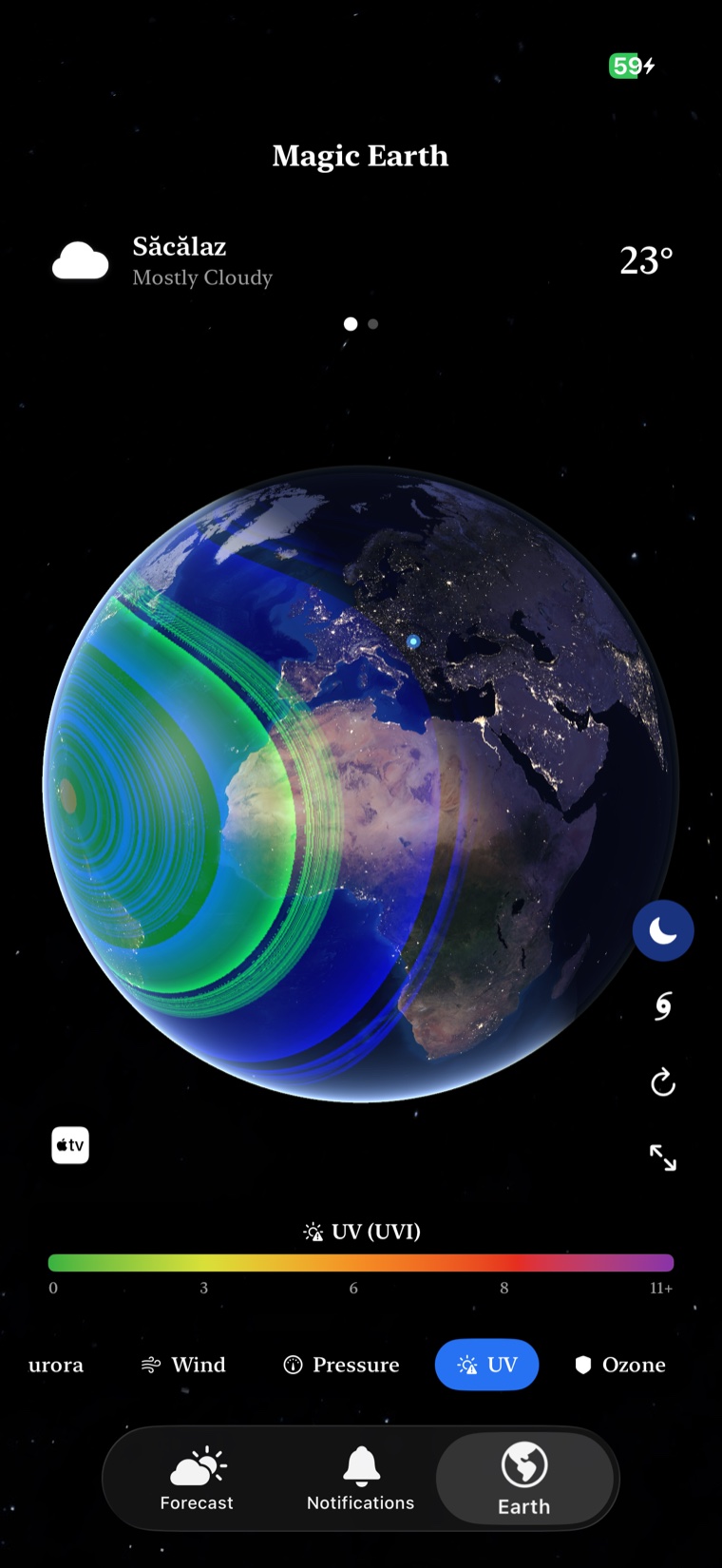
- The Aurora layer on the Earth tab paints the current chance of aurora over the globe, with a scale from low to high. Spin to the pole to see the whole oval.
- Day and night are drawn in their real positions, so you can see whether it is dark where the oval is.
- Clouds are one tap away on the same globe. Switch layers to check whether your sky is clear.
- Aurora watch is one of the experimental alerts in the Beta Notifications section of the Notifications tab.
- Weather Chat can answer questions about aurora on devices with Apple Intelligence.
Common questions
What Kp index do I need to see the northern lights?
It depends on how far north you are. Inside the Arctic Circle, Kp 1 to 3 is often enough. Around 55 to 60 degrees north, such as Scotland or southern Sweden, you need about Kp 5. Around 50 degrees north, such as southern England or Germany, about Kp 7. Further south you need Kp 8 or 9.
What is the best time of night to see the aurora?
The hours around local midnight, roughly 10 PM to 2 AM, are usually best. Displays can happen at any time when the sky is dark, and strong storms are visible from dusk to dawn.
What is the best time of year for the northern lights?
From September to March in the Northern Hemisphere, when nights are long and dark. Activity tends to be strongest around the equinoxes in September and March.
Can my phone camera see the aurora better than my eyes?
Yes. A phone in night mode collects light for several seconds, so it records colour and detail that the eye cannot see in a faint display. If you suspect a pale glow on the northern horizon, take a photo.
Stargazing weather: how to tell if tonight is a good night for the stars
A clear forecast is not enough. Check cloud height, humidity, wind, the moon and how dark your sky is. A checklist for picking a good night for stars.
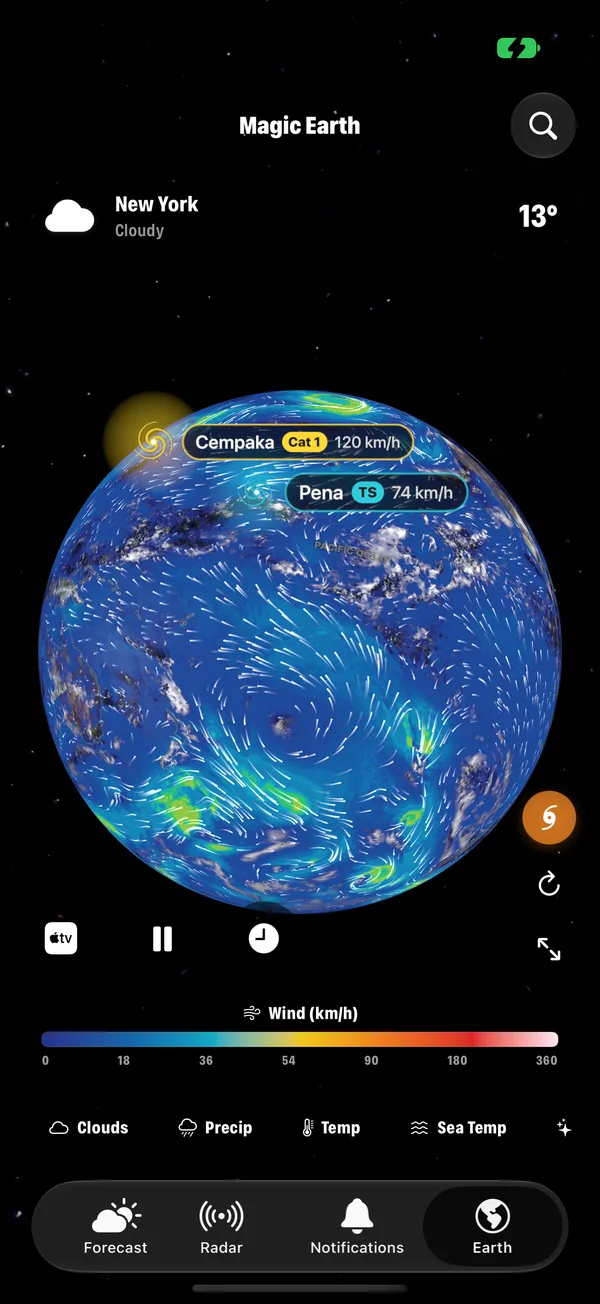
Every Earth layer in Magic Weather, explained
Clouds, rain, temperature, wind, pressure, sea temperature, aurora, UV, ozone, satellites, earthquakes and fires: what each Magic Weather layer shows.
How weather satellites photograph the whole Earth
Two kinds of satellite watch the weather: one hovers 36,000 km up, the other sweeps pole to pole. Here is how their pictures become a cloud map.