A rainbow forms when sunlight enters raindrops, reflects off the back of each drop and leaves again, split into colours. The light comes back at 42 degrees from the direction opposite the sun. To see one you need the sun behind you, rain in front of you, and the sun lower than 42 degrees above the horizon. The best chances are in the early morning or late afternoon, as a shower moves away and the sun comes out.
What happens inside a raindrop
A falling raindrop is close to a perfect sphere. When a ray of sunlight meets it, three things happen in turn.
- It bends on the way in. Light slows down as it passes from air into water and changes direction. Each colour bends by a slightly different amount: violet the most, red the least.
- It reflects off the back. Some of the light bounces off the inside of the far wall of the drop.
- It bends again on the way out, spreading the colours further apart.
The light leaves the drop heading back toward the sun, but not straight back. It is concentrated at an angle of about 42 degrees for red and 40 degrees for violet. That narrow concentration is the rainbow.
The geometry: why it is always in the same place
Imagine a line from the sun through the back of your head and out through your eyes. It points at the shadow of your head on the ground. That spot is called the antisolar point, and it is the centre of every rainbow you will ever see.
The bow is a circle around that point with a radius of 42 degrees. Because the antisolar point is below the horizon whenever the sun is up, you normally see only the top part of the circle: an arc.
Three consequences follow:
- The rainbow is always opposite the sun. If you are looking toward the sun, you will never see one.
- The lower the sun, the bigger the arc. At sunrise or sunset the antisolar point is on the horizon and the bow is a full semicircle. As the sun climbs, the bow sinks.
- Above 42 degrees, no bow. When the sun is higher than that, the entire circle is below the horizon. From an aircraft or a mountain, with rain below you, you can see the full circle.
When to expect one
You need three things at once: sun, rain and the right angle.
- Showers, not solid rain. A front with unbroken cloud hides the sun. Showery days, with rain and bright gaps close together, are rainbow days.
- Early or late. In summer at mid-latitudes the sun is above 42 degrees for several hours around midday. Before about 9 AM and after about 5 PM is the window. In winter the sun stays low enough all day.
- The shower moving away from the sun. In much of the mid-latitudes weather comes from the west. A shower that has just passed you in the late afternoon is to your east, with the sun now out in the west behind you. That is the classic evening rainbow.
- A dark background. The bow is brightest against the dark cloud of the departing shower.
A radar loop makes this practical. If a shower is about to pass and there is a clear gap behind it on the sunward side, go outside as the rain eases and look away from the sun.
Double rainbows and other bows
- The secondary bow comes from light that reflects twice inside the drops. It sits outside the main bow at about 51 degrees, fainter, with red on the inside.
- Alexander's band is the darker strip of sky between the two bows. The sky inside the main bow is noticeably brighter than the sky outside it.
- Supernumerary bows are faint pink and green fringes just inside the main bow, seen when the drops are small and even in size.
- A fogbow forms in fog or mist. The droplets are so small that the colours overlap into a broad white arc.
- A moonbow is a rainbow lit by a bright moon. It looks white to the eye because the light is too faint for colour vision. A camera shows the colours.
- A red rainbow appears at sunset, when only red light is left in the sun's rays.
Rainbow watch in Magic Weather
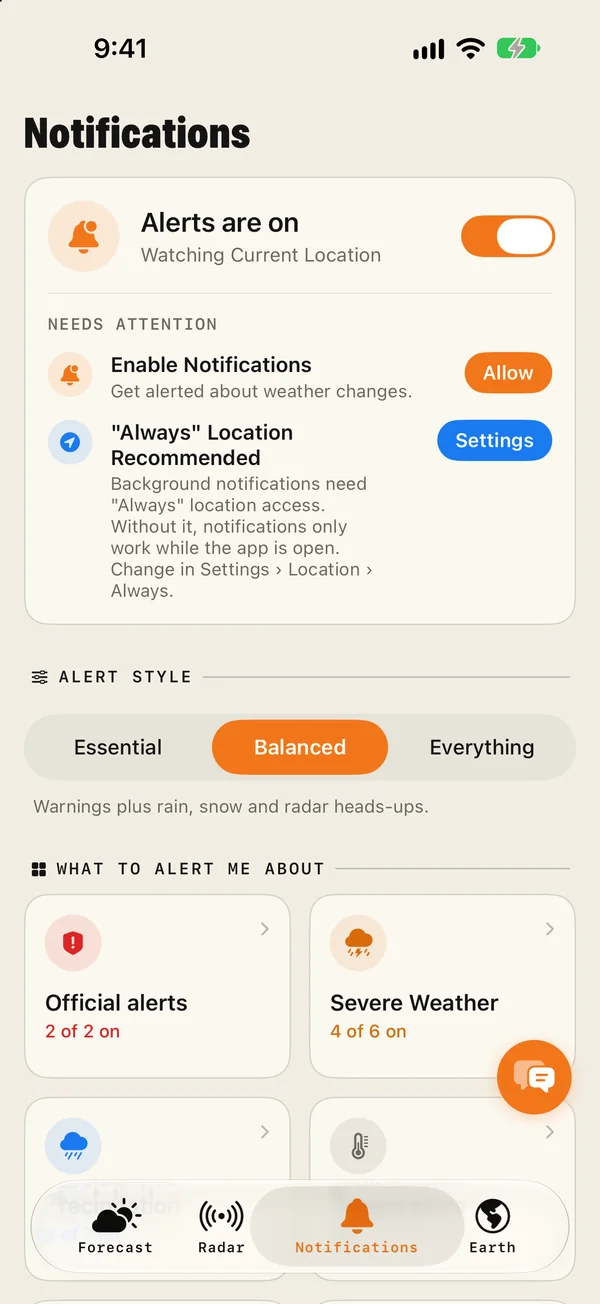
- Rainbow watch is one of the experimental alerts in the Beta Notifications section. It looks for sun and rain lining up where you are.
- The Radar tab shows where the showers are and plays how they have been moving, so you can see when one is about to clear.
- Rain timing appears under the hero on the Forecast tab, including when the rain is due to stop.
- Sunrise and sunset tiles tell you whether the sun is low enough.
Common questions
Where should I look for a rainbow?
Stand with your back to the sun and look toward the rain. The rainbow is centred on the point directly opposite the sun, which is where the shadow of your head falls. The lower the sun, the higher the bow.
Why can't I see a rainbow at midday?
The bow sits 42 degrees from the point opposite the sun. When the sun is higher than 42 degrees above the horizon, the whole bow is below the horizon. In summer at mid-latitudes that rules out the middle of the day.
What causes a double rainbow?
Light that reflects twice inside the raindrops instead of once. The second bow appears outside the first, at about 51 degrees, and is fainter with its colours in reverse order.
Can two people see the same rainbow?
Not exactly. Each person sees light from a different set of raindrops, at 42 degrees from their own eyes. Two people standing side by side see two slightly different rainbows.