
According to NOAA, a 5-day forecast is accurate about 90% of the time, a 7-day forecast about 80%, and a forecast for 10 days or more is right only about half the time. Temperature is the most reliable part. The exact timing and amount of rain are the least reliable.
The numbers
The United States weather agency NOAA puts it simply:
"Right" here means the forecast was close: temperatures within a few degrees and the general character of the day correct. It does not mean every hour matched.
Why accuracy falls with time
A forecast starts with a snapshot of the atmosphere, built from satellites, weather balloons, aircraft, ships and ground stations. A computer model then steps that snapshot forward in time using the laws of physics.
The snapshot is never perfect. There are gaps over oceans and deserts, and every instrument has a small error. The atmosphere is a chaotic system, which means small errors do not stay small. They roughly double every few days, until by about two weeks the forecast is no better than the long-term average for the date.
This limit was discovered in the 1960s by the meteorologist Edward Lorenz, and it is why no amount of computing power will produce a reliable hourly forecast for a month from now.
What is easy to forecast, and what is hard
| Easier | Harder |
|---|---|
| Temperature, especially daytime highs | Exactly where a shower or thunderstorm will form |
| Large storms and fronts, days ahead | Rain totals, to the millimetre |
| Heat waves and cold snaps | Fog, and when it will lift |
| Wind direction and general strength | Whether precipitation falls as rain or snow near 0 °C |
| Settled weather under high pressure | Timing, once you look more than three days ahead |
The pattern is about size. Big things, such as a low-pressure system a thousand kilometres across, are well observed and well modelled. Small things, such as a single thunderstorm, fall between the points of a model's grid.
How to read each range
- Today and tomorrow: trust the hours. Plan around the dry gaps you see on the hourly graph, and use radar for the next hour or two.
- Days 3 and 4: trust the part of the day. "Rain in the afternoon" is solid. "Rain at 3 PM" is not.
- Days 5 to 7: trust the day's character. Warm or cool, dry or unsettled. Expect the timing to shift by half a day.
- Beyond a week: trust only the trend, and check again later.
Two habits make any forecast more useful. Check again as the day gets closer, because each new model run has fresher data. And notice when the forecast keeps changing: a day whose forecast flips with every update is a day the models are unsure about.
Forecasts keep improving
Weather forecasting has gained about one day of accuracy per decade for the past forty years. A 5-day forecast today is roughly as good as a 1-day forecast was in 1980. Better satellites, faster computers and finer model grids all contribute, and so do ensembles: instead of running the model once, forecast centres run it dozens of times with slightly different starting points. When the runs agree, confidence is high. When they scatter, the honest answer is a probability, which is where figures such as a 40% chance of rain come from.
Different forecast models still give different answers, which is one reason two weather apps can disagree about the same afternoon.
Using the week in Magic Weather
- The week shows seven days with a green dot on the nicest day and a red dot on the roughest, so the overall shape is clear at a glance.
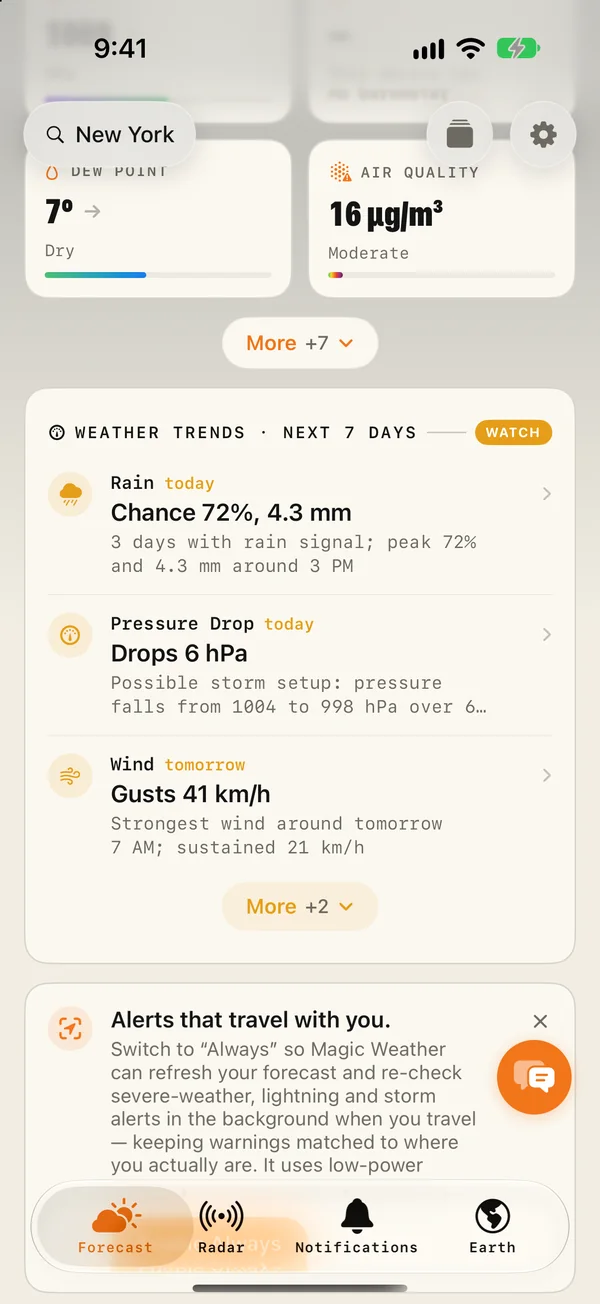
- Weather Trends looks a week ahead and lists what is changing: rain, wind, a pressure drop. This is the right level of detail for days five to seven.
- The weathergraph gives the hour-by-hour picture for the near days, where hours can be trusted.
- Forecast provider: Settings › Locations & weather data lets you choose which forecast engine the app uses, or leave it on Automatic.
Common questions
How accurate is a 10-day weather forecast?
A forecast for 10 days or longer is right about half the time. It is useful for spotting a trend, such as a warm spell or an unsettled period, and not for planning around a particular hour or day.
How accurate is a 7-day forecast?
About 80% accurate, according to NOAA. Temperatures are usually within a few degrees. Whether it rains on a particular afternoon is much less certain at that range.
Why is the forecast wrong so often for rain?
Showers and thunderstorms are small and form quickly, so models can predict that they will occur in a region without knowing exactly where. Large rain bands from fronts are forecast far more reliably.
Are weather forecasts getting better?
Yes. Forecasts have gained roughly one day of accuracy per decade. A modern 5-day forecast is about as accurate as a 1-day forecast was in 1980.