
A 40% chance of rain means that, at your location, there is a 4 in 10 chance of measurable rain (at least 0.2 mm, or 0.01 inch) during the forecast period. On 10 days with the same forecast, you would get wet on about 4 of them. It says nothing about how long the rain lasts or how heavy it is.
The real definition
Forecasters call this number the probability of precipitation, or PoP. It answers one narrow question: what is the chance that a rain gauge at a given point collects a measurable amount of water during the forecast period?
"Measurable" has a precise meaning: 0.2 mm in most of the world, 0.01 inch in the United States. The "period" is whatever the forecast covers, usually an hour, half a day or a whole day.
The classic formula used by forecasters is:
PoP = confidence × coverage
If a forecaster is 80% confident that showers will form, and expects them to cover half the area, the result is 0.8 × 0.5 = 40%. If they are 40% confident that a band of rain will arrive at all, but know it would soak everyone, the result is also 40%.
Three things the number does not mean
- Not 40% of the day. Duration is not part of the calculation. A 90% day might be one heavy shower at dawn.
- Not 40% as hard. Intensity is separate too. A 30% chance can come with a thunderstorm, and a 100% chance can be drizzle.
- Not "40% of forecasters think so". It is a calibrated probability. A good forecaster's 40% days end up wet about 40% of the time.
Chance, amount and timing are three different readings
To plan properly you need all three, and they often disagree in useful ways.
| Chance | Amount | What to expect |
|---|---|---|
| 90% | 0.5 mm | It will almost certainly rain, and you will barely notice. Light drizzle. |
| 30% | 12 mm | Probably dry. If a shower finds you, it will be heavy. Typical summer thunderstorm setup. |
| 80% | 25 mm | A properly wet day. Plan indoors. |
| 20% | 0.3 mm | Ignore it. |
This is why a chart that shows both is far more useful than a single icon. On a meteogram, the bars show the amount per hour, so you can see whether a wet day is six hours of light rain or one violent hour.
Why the daily number looks so high
People are often surprised to see a 70% day made of hours that each say 20%. There is no contradiction. The daily value is the chance that it rains at some point, and many small chances add up.
If six separate hours each have a 20% chance and they are independent, the chance that all six stay dry is 0.8 multiplied by itself six times, about 26%. So the chance of rain at some point is about 74%.
The practical lesson: use the daily chance to decide whether to carry a jacket, and the hourly chance to decide when to go out.
How to act on the number
Two refinements make this much sharper:
- Showers or a front? Scattered showers give mid-range percentages for hours, and most people stay dry most of the time. A front gives a short window of very high percentages. The radar tells you which one you are dealing with. See how to read weather radar.
- How far ahead? A 60% chance for tomorrow is solid information. A 60% chance for next Saturday is a hint. Forecast accuracy falls with every day.
Reading rain in Magic Weather
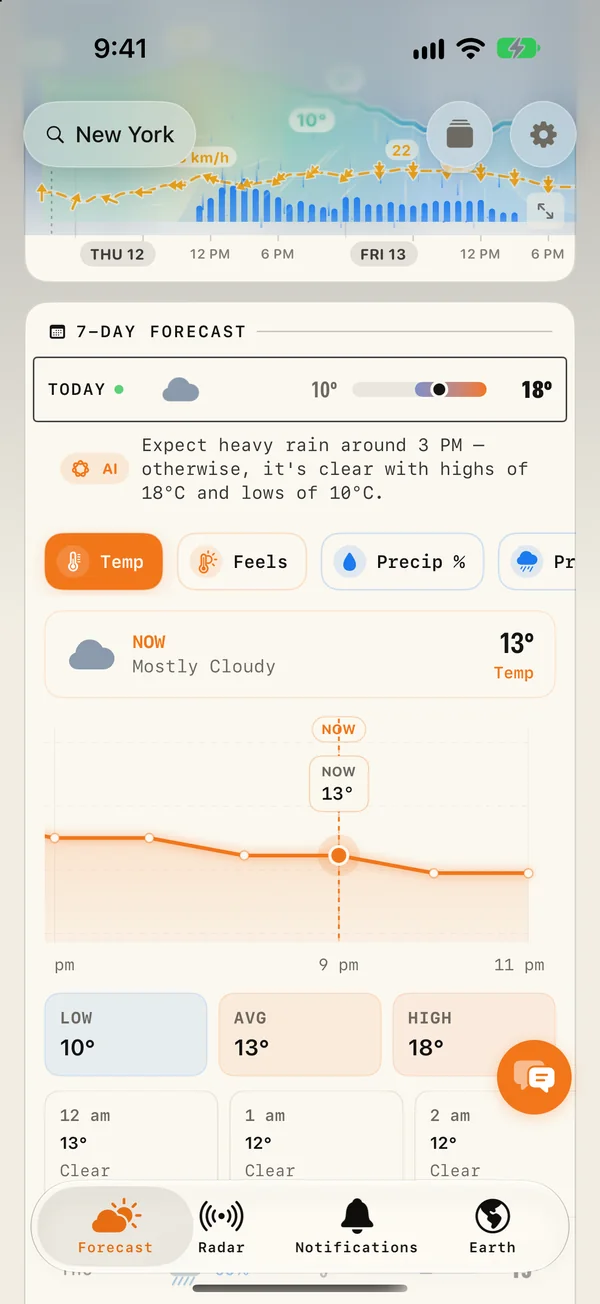
Magic Weather keeps the three readings apart so you can see each one clearly:
- The week shows the chance of rain next to each day that has one.
- Open a day and pick Precip % for the hourly chance or Precip for the hourly amount. The cards below show the day's total.
- The weathergraph draws a bar for every wet hour, taller for more rain.
- The line under the hero tells you the next change worth knowing, such as when the rain starts.
- Rain alerts can tell you shortly before rain starts or stops at your location. Here is how to set them up.
Common questions
Does 40% chance of rain mean it will rain for 40% of the day?
No. The percentage is the probability that any measurable rain falls at your location during the period. A 40% day can bring a ten-minute shower, six hours of drizzle, or nothing at all.
Does it mean 40% of the area will get rain?
Not exactly. Forecasters can arrive at 40% by being sure of rain over 40% of the area, or by being 40% sure of rain everywhere. For you, standing in one spot, both cases mean the same thing: a 4 in 10 chance of getting wet.
Why is the daily chance higher than every hourly chance?
The daily figure is the chance of rain at any time in the day. Several hours with a modest chance each add up. Six hours at 20% each give a daily chance of roughly 70% if the hours are independent.
How much rain counts as rain?
Most weather services count 0.2 mm (0.01 inch) or more as measurable precipitation. That is enough to wet the pavement, not enough to make a puddle.