
Count the seconds between the flash and the thunder. Divide by 3 to get the distance in kilometres, or by 5 for miles. Nine seconds means the strike was about 3 km (2 miles) away. If the gap is 30 seconds or less, the storm is close enough to strike you: go indoors and stay there until 30 minutes after the last thunder.
The counting method
- See the flash and start counting seconds. "One thousand and one, one thousand and two" keeps the pace honest.
- Stop when the thunder starts. Use the first rumble, not the loudest one.
- Divide by 3 for kilometres, or by 5 for miles.
| Seconds | Distance | What it means |
|---|---|---|
| 3 | 1 km (0.6 miles) | Dangerously close. You should already be inside. |
| 9 | 3 km (2 miles) | Well within striking range. |
| 15 | 5 km (3 miles) | Still within range. Stay sheltered. |
| 30 | 10 km (6 miles) | The limit. Go indoors now. |
| 60 | 20 km (12 miles) | About as far as thunder carries. Watch which way it is moving. |
Why it works
Light travels at about 300,000 kilometres per second, so the flash reaches you in effect instantly. Sound travels at about 343 metres per second in mild air, roughly a kilometre every three seconds, or a mile every five.
Thunder is the sound of air being heated by the lightning channel to around 30,000 °C, several times hotter than the surface of the sun, in a fraction of a second. The air expands violently and sends out a shock wave. It rumbles rather than cracks because sound from different parts of a channel several kilometres long reaches you at different times.
Is it coming or going?
Count twice, a few minutes apart. If the gap is getting shorter, the storm is approaching. If it is getting longer, it is moving away. A storm moving at 40 km/h covers about 3 kilometres in five minutes, so the count changes quickly.
A radar loop shows the same thing with more certainty, and shows whether more cells are lined up behind the first.
The 30-30 rule
- First 30: if the time between flash and thunder is 30 seconds or less, get indoors. The storm is within 10 kilometres and can reach you with its next strike.
- Second 30: wait 30 minutes after the last thunder before going back out. Many strikes happen at the trailing edge of a storm, when the rain has stopped and people assume it is over.
Many safety agencies now put it more simply: when thunder roars, go indoors. If you can hear it at all, you are close enough to be struck.
Where to shelter, and where not to
| Safe | Not safe |
|---|---|
| A proper building with wiring and plumbing | Under a tree. This is the most common place people are struck. |
| A hard-topped car or bus, windows shut | Tents, bus shelters, gazebos, porches |
| Open fields, hilltops, beaches, golf courses | |
| In or on water. Get out of the pool, the lake or the sea. |
Indoors, stay away from corded phones, plumbing and windows until the storm passes. A mobile phone is safe to use.
If you are caught in the open with no shelter, move away from high ground and isolated tall objects, spread out if you are in a group, and keep moving toward shelter. No position in the open is safe. The aim is to be less exposed while you get somewhere better.
Lightning facts worth knowing
- It is constant. Lightning flashes about 44 times every second somewhere on Earth, well over a billion times a year.
- It strikes ahead of the rain. "Bolts from the blue" can land 15 kilometres or more from the storm, under a clear sky.
- It does strike twice. Tall buildings are hit dozens of times a year.
- Most victims survive, but often with lasting injuries. Call for help and start first aid at once: a person who has been struck carries no charge and is safe to touch.
Lightning in Magic Weather
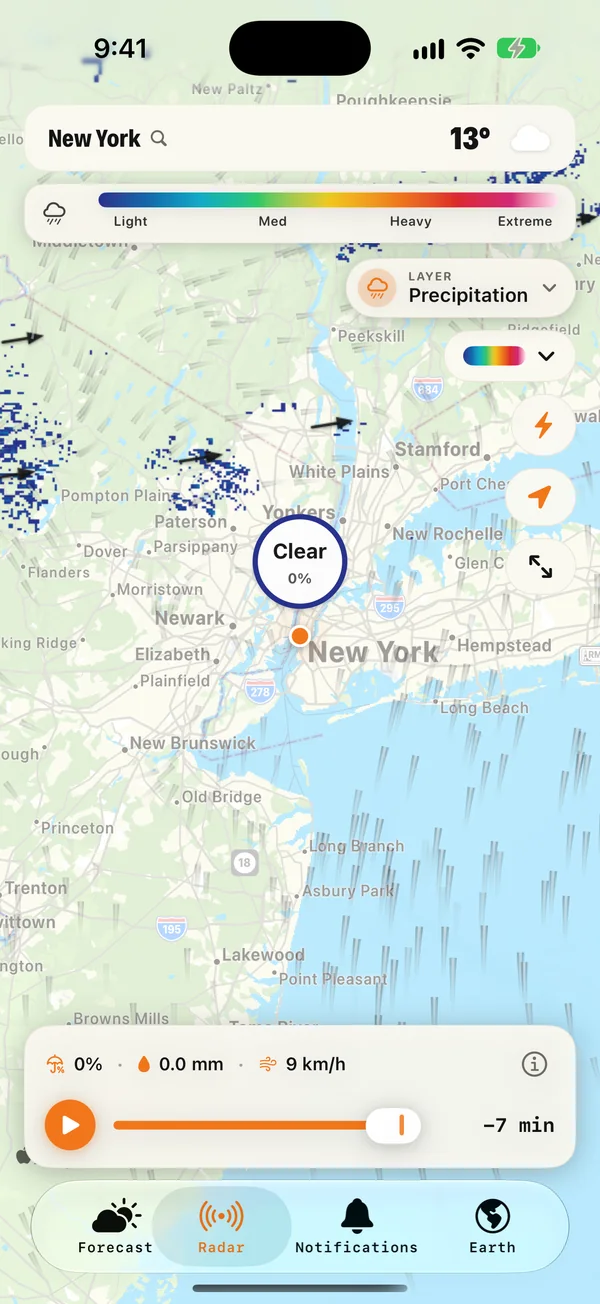
- On the Radar tab, the lightning button shows live strikes on the map, so you can see how far the active part of a storm is from you.
- On the Earth tab, lightning flashes can be shown on the globe.
- Alerts: the Severe weather category includes storms and lightning. Here is how to set it up.
- Weather Trends flags days with a lightning signal in the week ahead.
Common questions
How do you calculate how far away lightning is?
Count the seconds from the flash to the start of the thunder. Divide by 3 for the distance in kilometres or by 5 for miles. Sound travels about 343 metres per second, so every 3 seconds is roughly 1 kilometre.
How far away can lightning strike?
Lightning can strike 15 kilometres (10 miles) or more from the rain, sometimes from a clear sky beside the storm. If you can hear thunder, you are within range.
Is it safe to be in a car during lightning?
Yes, in a hard-topped car with the windows closed. The metal body carries the current around you to the ground. The rubber tyres are not what protects you. Convertibles, motorbikes and bicycles offer no protection.
Can you see lightning without hearing thunder?
Yes. Thunder is rarely heard beyond about 15 to 25 kilometres, but the flash can be seen from 100 kilometres or more at night. Silent distant flashes are sometimes called heat lightning.
How to read weather radar: colours, movement and what radar misses
Radar colours show how hard it is raining, and the loop shows where the rain is heading. Learn to read both, and the blind spots every radar has.
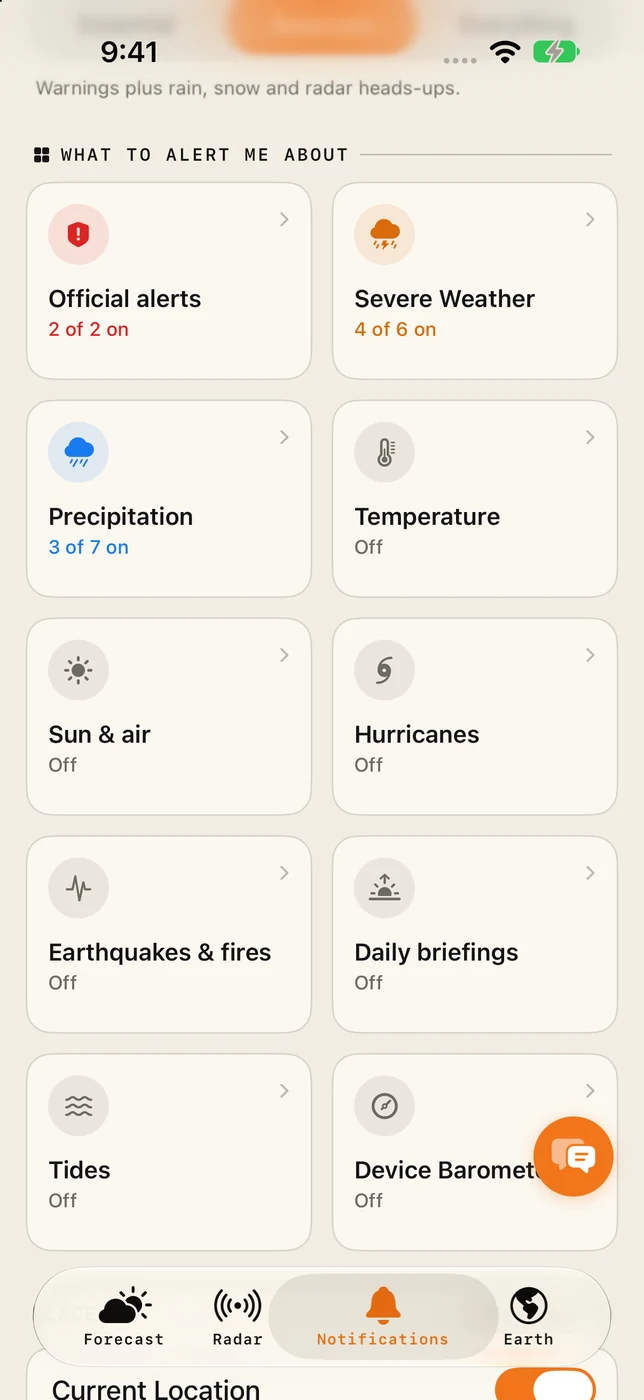
Severe weather alerts on iPhone: how to set them up properly
Set up severe weather alerts on iPhone with Magic Weather: official warnings, storms, lightning, wind and hurricanes, for home and every place you watch.
Hurricane categories explained: what Category 1 to 5 really mean
Hurricane categories measure wind speed only. See the full Saffir-Simpson scale, what the cone of uncertainty shows, and why water is the bigger danger.